Foundation only
This module prepares you to begin approved EMT education. It does not provide certification, course credit, local protocols, medical direction, or authorization to perform patient care.
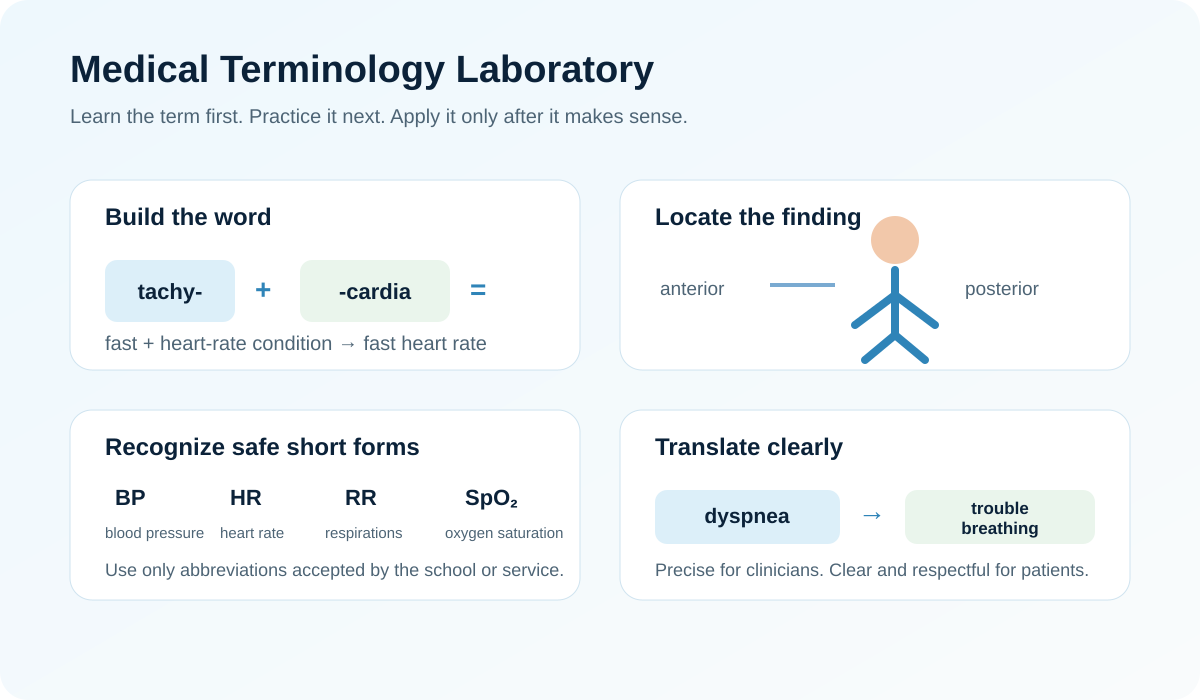
Learning objectives
- Explain prefixes, roots or combining forms, and suffixes before using them to decode a word.
- Recognize a focused set of high-value EMT terminology rather than trying to memorize an entire medical dictionary.
- Use anatomical position and directional terms correctly on a body diagram.
- Translate medical language into respectful patient-friendly language and objective documentation.
- Decode a short EMS note only after every term in that note has been taught and practiced.
1. Learn how medical words are built
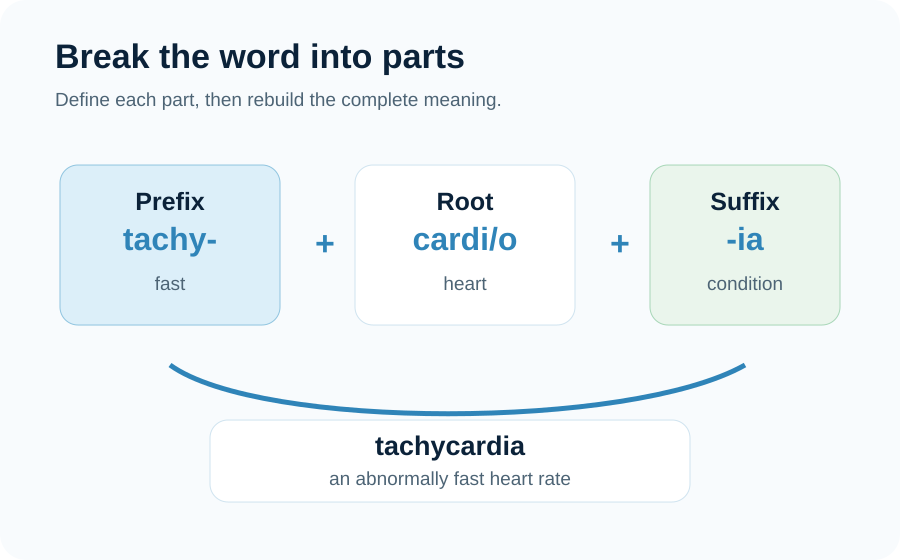
Many medical words can be understood by separating them into smaller parts. A word may contain a prefix, a root or combining form, and a suffix. Not every word has all three parts, and real medical terminology has exceptions, but this method gives beginners a reliable starting point.
Prefix
Appears at the beginning and often changes speed, amount, position, or quality. Example: tachy- means fast.
Root or combining form
Provides the core body part or idea. Example: cardi/o relates to the heart.
Suffix
Appears at the end and often identifies a condition or process. Example: -pnea relates to breathing.
Worked example: tachycardia
tachy- means fast and -cardia relates to heart rate. In plain language, tachycardia means an abnormally fast heart rate. The exact threshold and clinical importance depend on the patient and context.
2. Learn high-value prefixes before using them
These prefixes appear often in beginner EMT material. Learn the meaning and one example before using them in a simulator.
3. Learn useful roots and suffixes
The goal is recognition and safe communication—not memorizing every possible term before EMT school.
Roots and combining forms
- cardi/o
- heart
- pneum/o or pulmon/o
- lung or air
- neur/o
- nerve or nervous system
- gastr/o
- stomach
- hemat/o or hem/o
- blood
- derm/o
- skin
- cephal/o
- head
- thorac/o
- chest
- abdomin/o
- abdomen
Suffixes
- -itis
- inflammation
- -emia
- blood condition
- -pnea
- breathing
- -algia
- pain
- -megaly
- enlargement
- -uria
- urine condition
- -cyte
- cell
- -osis
- condition, often abnormal
- -pathy
- disease or disorder
4. Learn anatomical position and directional terms
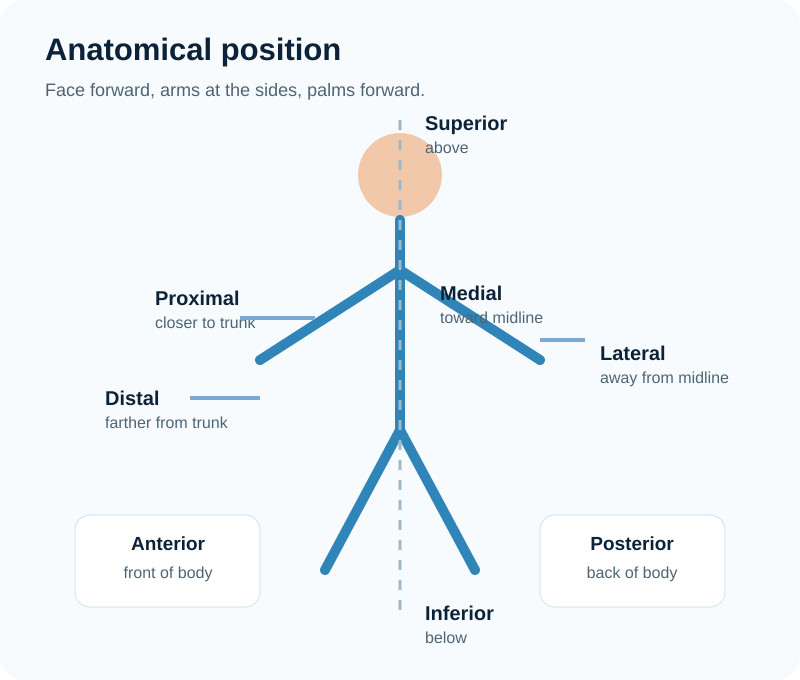
Anatomical position means the person is standing upright, facing forward, with arms at the sides and palms facing forward. Directional terms are based on the patient’s body—not the observer’s viewpoint.
- anterior / posterior
- front / back
- superior / inferior
- above / below
- medial / lateral
- toward the midline / away from the midline
- proximal / distal
- closer to / farther from the trunk or point of attachment
- bilateral / unilateral
- on both sides / on one side
- upper / lower extremity
- arm / leg
5. Learn a focused set of EMS abbreviations
Abbreviations can save space, but they may also be misunderstood. Use only abbreviations accepted by your school, service, electronic chart, and local policy. The activity below uses only the terms taught here.
6. Translate medical language into clear, objective language
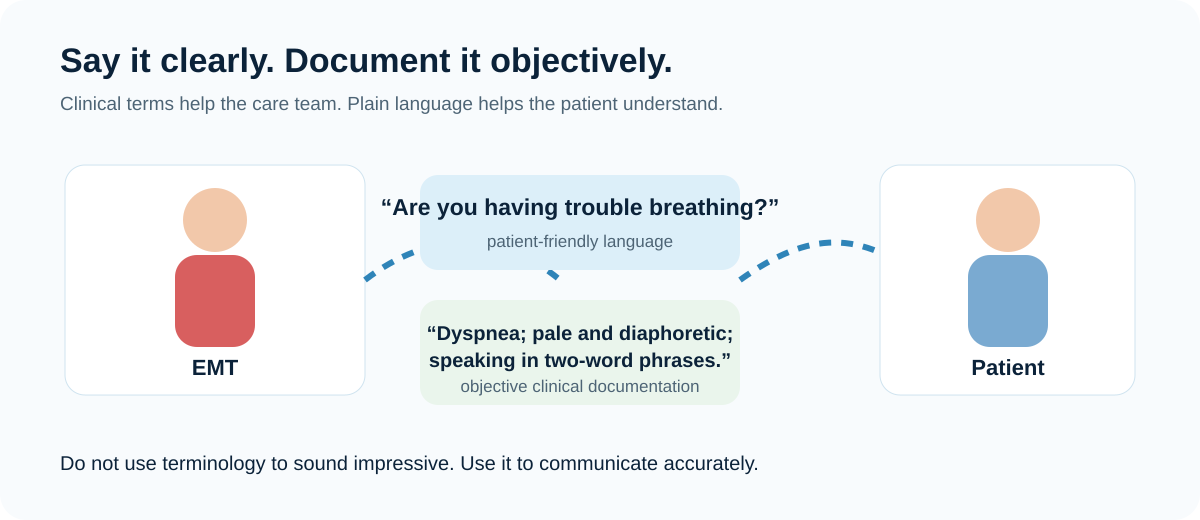
Medical terms are useful between trained clinicians, but patients and families may need plain language. Documentation also needs objective observations rather than vague or judgmental descriptions.
Medical term
Dyspnea means difficult or uncomfortable breathing. A patient-friendly question is, “Are you having trouble breathing?”
Objective observation
Instead of “patient looks bad,” document visible findings such as “pale, diaphoretic, speaking in two-word phrases.” Diaphoretic means visibly sweaty.
Tachycardia
An abnormally fast heart rate. In patient-friendly language: “Your heart rate is faster than expected.”
Edema
Swelling caused by fluid in tissues. Bilateral lower-extremity edema means swelling in both legs.
Capstone vocabulary taught before the scenario
Adult patient with dyspnea, tachycardia, and bilateral lower-extremity edema means an adult with difficult breathing, a fast heart rate, and swelling in both legs. You will use this exact vocabulary in the final simulator below.
Create your personal terminology review list
Record three terms you want to review again and rewrite each one in plain language. Your notes save only on this device.
Check your understanding
Every term below was introduced and practiced earlier in this module.
Helpful links and practice tools
EMT flashcards
Open tool →MedWord terminology game
Open game →MedlinePlus medical words
Open resource →OpenStax anatomy reference
Open resource →Mark this module complete when ready
You should be able to break apart a taught term, use directional language, translate a short EMS phrase, and explain why word parts are clues rather than diagnoses.